
Chesterfield County Most Wanted Sources
Chesterfield County works with two separate sources, and mixing them up causes confusion. The Chesterfield County Police Department Active Warrants report is an official public record pulled from the CCPD Records Management System. The county's Active Calls and Incidents hub says it gets refreshed twice a day. That same hub warns that details shift quickly, that data gaps happen, and that some active warrants never make the report at all. So a search that comes up empty is not the same as a clean record. The other source is the Chesterfield/Colonial Heights Crime Solvers' Sheriff's Most Wanted page. This one is curated, not comprehensive. Expect a dated heading, photo tiles, names, and short text describing the warrant. A control at the bottom reveals more entries. Its size shifts over time, so treat it as a selection of people police want help locating, not a full count of county warrants. The split matters in practice. CCPD's report covers active-warrant information recorded by Police. Crime Solvers picks certain individuals for public assistance. Someone can be missing from the curated page and still have an open warrant question. A public entry, likewise, says nothing about custody status, bond, court appearances, or how a charge may have changed. The Crime Solvers Most Wanted source presents these public-safety notices through its own photo-bearing layout.

What appears here is the source interface itself. No wanted list is reproduced, and a photo on the source page says nothing about current warrant status.
Note: Chesterfield’s official report and its Sheriff-linked list answer different public-safety questions, so neither should be used as a final legal determination.
Chesterfield County Wanted Listing Fields
Think of a wanted tile as a brief notice rather than a case file. The Crime Solvers page pairs each name with a photograph and a short line of warrant language, while the dated heading gives context for when that view went up. A safety message runs alongside the listings. None of it stands in for the actual warrant, an arrest record, a bond decision, or what a court eventually files.
| Published element | What it can indicate | What it cannot settle |
|---|---|---|
| Name | The identity used by the public-help notice. | That a person with a similar name is the same individual. |
| Photograph | A source-list identification aid. | Guilt, current custody, or permission to approach. |
| Short warrant or charge text | The limited reason the source asks for tips. | The full case history, final charge, or court outcome. |
| Dated heading and safety notice | That the list is a time-sensitive public-safety communication. | That every warrant is listed or remains active at viewing time. |
Public safety notices are deliberately thin. They leave out the affidavit, the witnesses, the evidence, and any hearing history. That brevity is by design, so no one should read a tile's wording as the last word on a case. The court holds that record, and charges can shift once a case is underway.
Use Chesterfield County’s Most Wanted List
The safe way to use a public wanted page is narrow. Spot a possible match. Keep only what a tip needs. Hand it to the listed public-safety channel and step back. Never contact, follow, confront, or try to detain anyone on the list, since Crime Solvers warns that these fugitives should be treated as armed and dangerous.
- Open the Sheriff-linked Crime Solvers list and note its dated context and the short information actually displayed.
- Compare only details needed to form a good-faith tip. Do not treat a name or image alone as proof of identity.
- For a nonemergency location tip, use Crime Solvers, P3, or the CCPD contact identified below. Call 911 when there is an emergency.
- For a capture, booking, or later court question, use the county’s official Chesterfield record paths rather than assuming that the wanted tile has been updated.
Chesterfield County Warrant Report Limits
The county publishes two distinct warrant lists, and mixing them into one imagined search tool misleads readers. The Active Warrants report is broader public-record output, but it comes with warnings about fast changes, gaps in the data, and exclusions. Crime Solvers runs smaller and curated. It may include photos under a dated public-help heading. Neither public view was documented as a search form with warrant-number, name, or case-status fields, so a page should not promise filters the county has not published.
Warrant labels matter, too. An arrest warrant generally concerns a charge presented for arrest. A bench warrant can follow a failure to appear or comply in court. A summons is a notice to answer in court, and it is not automatically a custodial warrant. For the exact status, terms, and next step, confirm with the responsible office or with counsel.
| Type or channel | Practical meaning | Safe next source |
|---|---|---|
| CCPD Active Warrants report | A public aid with limits and twice-daily updates. | CCPD, Sheriff/jail, court, or attorney for confirmation. |
| Sheriff’s Most Wanted | A curated public-safety list for tips. | Crime Solvers, P3, CCPD, or 911 when appropriate. |
| Arrest or bench warrant | A legal process whose details may change. | Court, attorney, or the official resolution route. |
| Summons or bond question | A person-specific court or custody issue. | Chesterfield County Jail at 804-748-1476. |
Note: A public report may be useful for awareness, but the county expressly warns that it can omit information or change after publication.
Check a Chesterfield County Warrant
Worried about a warrant, summons, or bond issue in your own name? The county's route is direct. The magistrate directory points outstanding-warrant and summons questions to the Chesterfield County Sheriff and jail line at 804-748-1476. Court Operations likewise directs people to the Chesterfield County Jail lobby at 6900 Mimms Drive, where a deputy can assist. Magistrates do not give legal advice, so an attorney or the court itself is the proper source for that. Chesterfield Court Operations lays out this official path for anyone resolving a warrant concern.
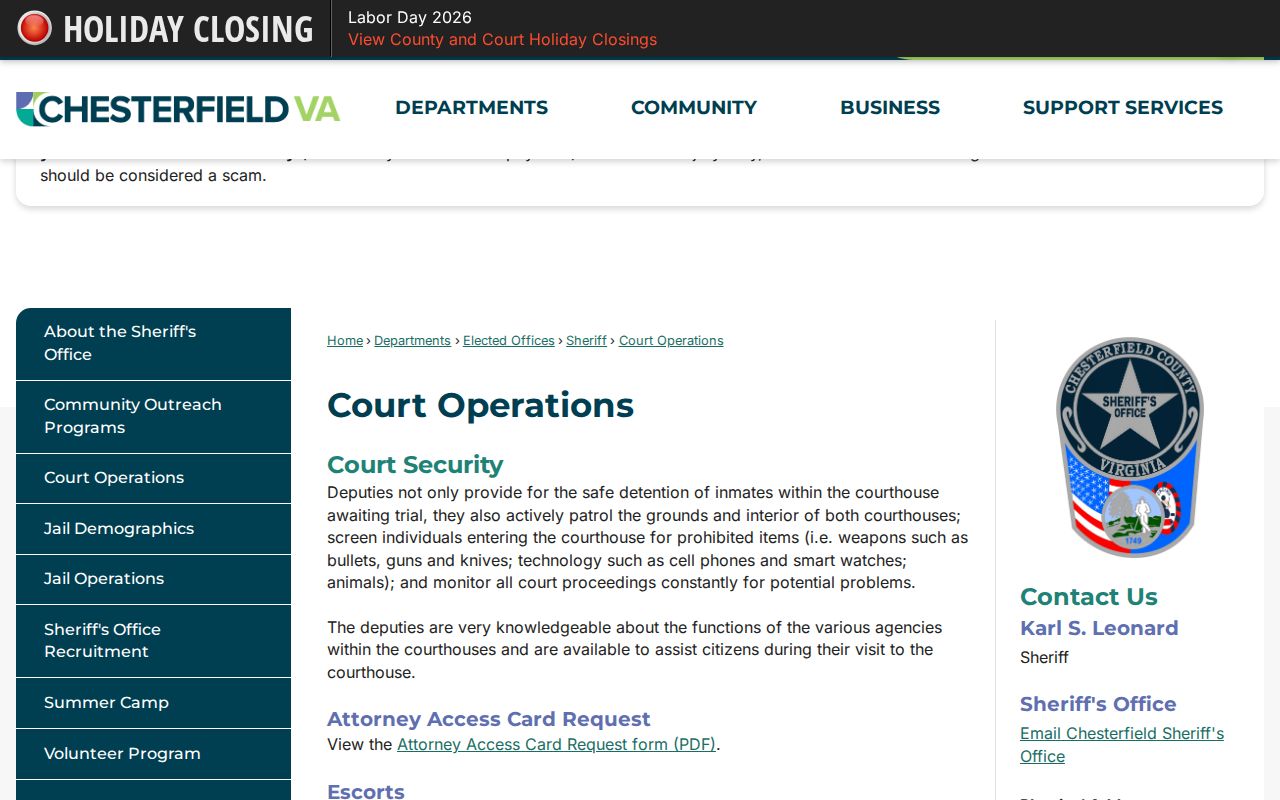
The Court Operations source backs one approach: ask a deputy at the jail lobby. It does not bless solving things through a public list or dodging service.
- Use the official report only as a public starting point, keeping its completeness warnings in mind.
- For a person-specific concern, contact the Sheriff/jail route at 804-748-1476 or the applicable court.
- Report to the jail lobby only as Court Operations directs, and ask a deputy for assistance.
- Seek independent legal advice from an attorney when advice about rights, appearance, bond, or case strategy is needed.
Chesterfield County Court Records Settle Outcomes
A wanted listing is only the start of the story. Once an arrest happens, a Chesterfield or Colonial Heights magistrate looks at probable cause and decides on bail or commitment to jail. From there, the jail can hold a person or release them while the case moves forward. Tracking that case means going to court records. For misdemeanors, traffic matters, and felony preliminary hearings, use the Virginia General District Court case system. Pick Chesterfield GDC, then search by name, case number, or date. The data is public but informational, so treat it as a lookup aid rather than the official judicial record.
Felonies move up to Circuit Court. When a docket is confusing or an official record is required, call the clerks directly. Court Operations lists the Circuit Court Clerk at 804-748-1241 and the General District Court Clerk at 804-748-1231. Cases end in many ways. A charge can be dismissed, amended, reduced, resolved by plea, or tried. The court file, not the wanted notice, shows that final outcome.
Know which question each source answers. A jail inquiry covers custody and bond right now. A court record tracks the charge itself and where it stands. The General District Court system helps locate a docket, but a clerk is the better contact for anything official.
Chesterfield County Wanted Tips Through P3
Crime Solvers is the channel for tips about people sought in Chesterfield. It offers P3 for anonymous reporting and also publishes a phone line. Chesterfield County Police notices point to the same pathway. P3 is a tip tool, nothing more. It is not a Sheriff roster, a booking-photo app, a warrant checker, or a court-record search. Keep that distinction straight before sending anything.
A good tip states what was seen and where. Leave identification work out of it; report only the facts. Crime Solvers sets its own anonymity terms, and no reward amount or policy has been documented, so assume nothing. If danger is immediate, call 911 instead. An app or web form will never bring a fast response.
P3 also cannot confirm an active warrant or a release. For bond status, use the jail line. For case progress, use the court's records. For legal advice, talk to a lawyer.